
Football
What it takes
Learn the technique
(Controlling the ball)
Learn the technique
(Passing the ball)
Learn the technique
(Dribbling the ball)
Learn the technique
(Shooting the ball)
What it takes
Talent
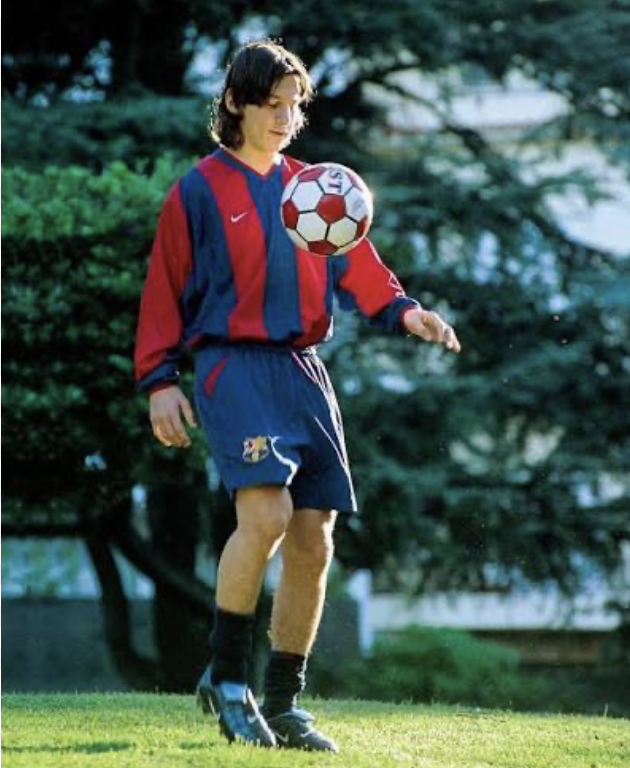
Talent is the base, the foundation a player needs to develop. It is through hard work and training that allows that tallent to flourish.
Physicality
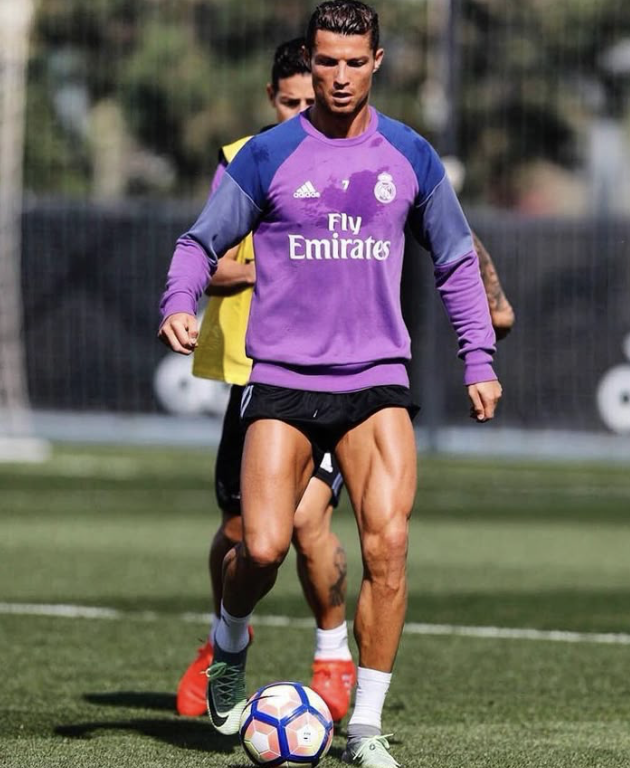
A player's physical condition can make him stand out among others. Explosiveness, power, and speed are all tools that a footballer must develop.
Intelligence

Being able to understand the game, to predict a movement, to understand defence patterns, is the key to creating chances preparing for them.
Mentality
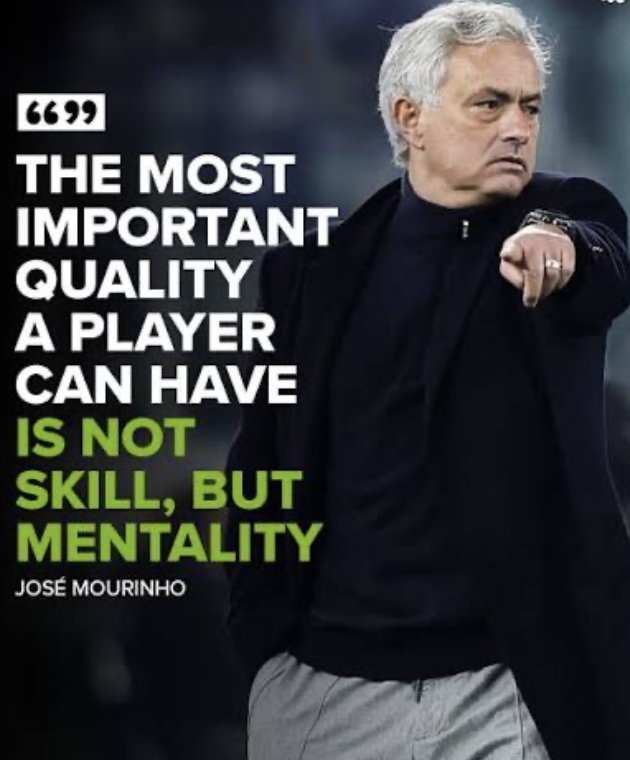
The early mornings, the late nights, the constant physical exhaustion, the dietery discipline . A player could have all the talent in the world, without the proper mentality, eventually he will burn out.
Learn the technique
(controlling the ball)
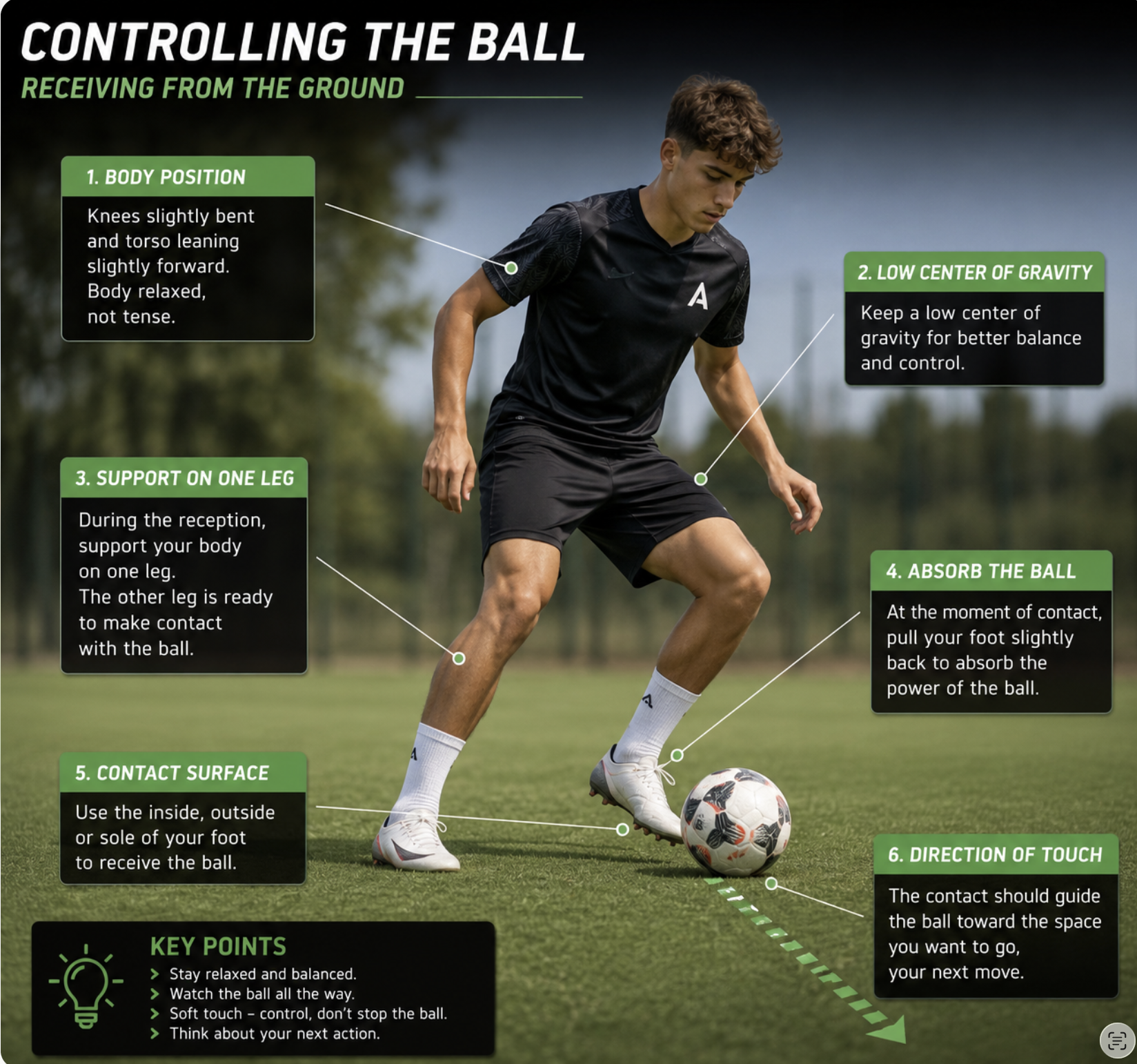
Receiving from the ground
Receiving from high balls
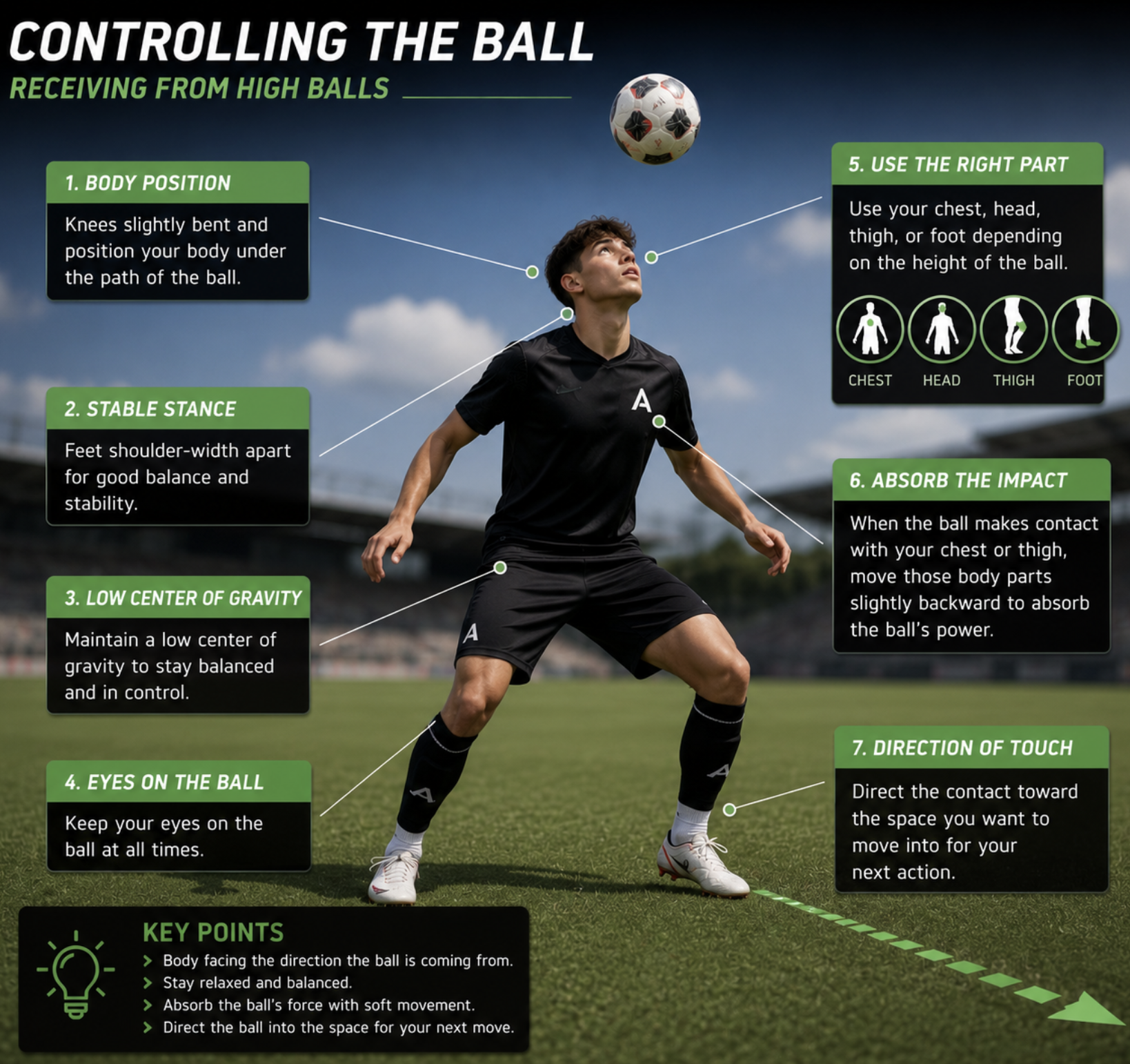
- Keep your knees slightly bent and your torso leaning a bit forward, ensuring your body remains relaxed rather than tense
- Receive the ball using the inside or outside of the foot, or the sole
- Maintain a low center of gravity. Support your weight on one leg while receiving the ball, with the other leg ready for contact.
- At the moment of contact, pull your foot back slightly to absorb the ball's momentum, directing the touch toward the area where you intend to make your next move.
- Keep your knees slightly bent and position your body beneath the ball's trajectory
- Place your feet shoulder-width apart for good balance and a low center of gravity, while keeping your eyes constantly on the ball
- Receive the ball using your chest, head, thigh, or foot, depending on its height, and face the direction from which the ball is coming.
- Upon contact with the chest or thigh, pull the body part slightly backward to absorb the ball's impact, ensuring the contact directs the ball toward the area where you intend to make your next move.
Learn the technique
(passing the ball)
Ground passes
Crosses
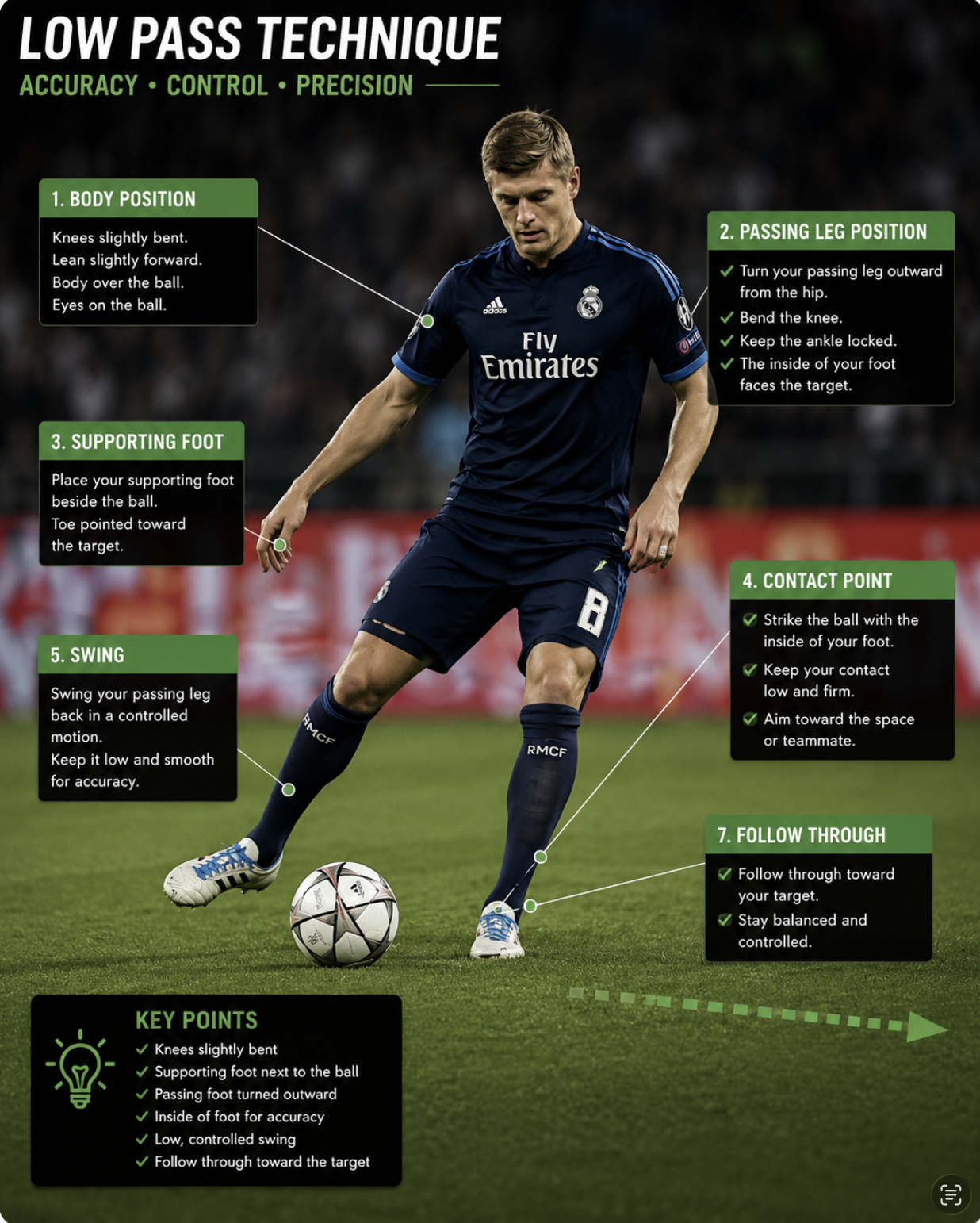
- With knees slightly bent, place the supporting foot next to the ball, pointing the toe toward the target
- Rotate the passing leg outward at the hip joint and bend it at the knee, keeping the ankle firm for accuracy and the inside of the foot facing the direction of the pass
- Then, execute a short swing of the leg, ensuring the body is slightly inclined forward and positioned over the ball.
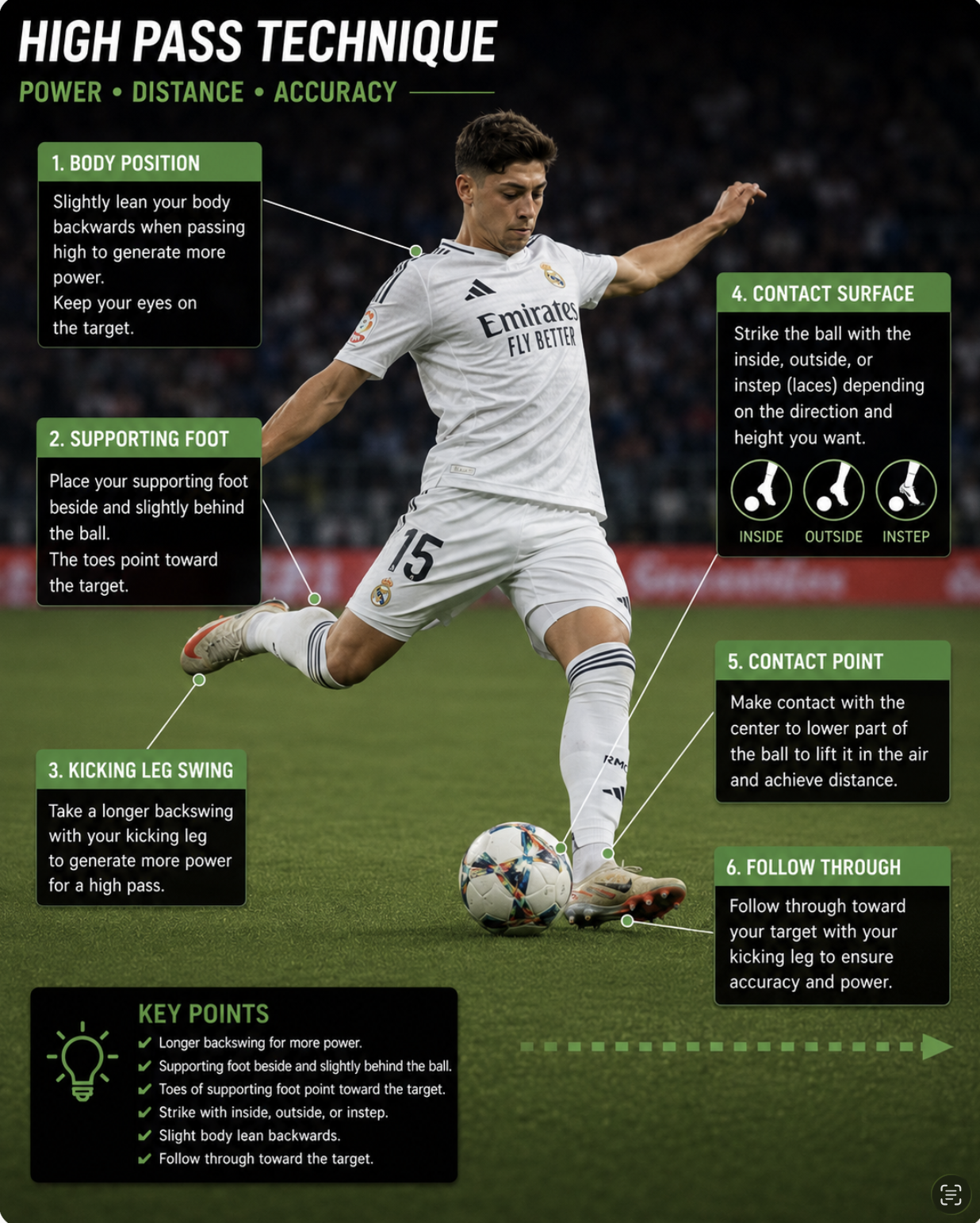
- The only differences compared to a low pass are that, for a high pass, the backswing of the kicking leg must be greater to generate more power, and the ball is struck using the inside, outside, or instep of the foot.
- The supporting foot is placed beside and slightly behind the ball
- The toes of the supporting foot point in the direction of the ball, and the body should be slightly tilted backward.
Learn the technique
(dribbling)
To execute a dribble correctly, one must maintain constant control and secure handling of the ball beforehand, observe the surrounding space and opponents, use a quick feint to throw the opponent off balance, and rapidly change direction and pace; following a successful dribble, the action should continue with a pass or a shot.
Skills to beat your opponent
Step-Over
- Step 1 : Dribble at the defender at a medium pace, keeping the ball close, about a step away
- Step 2 : Slow down a little, and approach at a slight angle
- Step 3 : Plant your non-stepping foot next to the ball
- Step 4 : Move your other foot around the ball in a circular motion. Your body should indicate you are heading toward that direction.
- Step 5 : Push the ball slightly in the other direction then take 2-3 explosive steps to accelerate.
Elastico
- Step 1 : Push the ball outward with the outside of your foot. Make small sideways pushes.
- Step 2 : After the push plant the same foot on the outside of the ball with a bit of power.
- Step 3 : Angle your foot slightly inward to create the "flip flap" motion
- Step 4 : Use the inside of the same foot to push the ball forward after the previous touch
- Step 5 : Blend both touches into one smoother, faster movement gradually by practicing the touches.
Marseille Turn
- Step 1 : Place the sole of your strong foot on the ball and drag it back. The ball should be placed in front of you with a slight distance from your body.
- Step 2 : After stepping on the ball begin to turn your upper body 90 degrees against the direction you want to turn to.
- Step 3 : When the ball starts rolling toward you continue turning your upper body
- Step 4 : Use the sole of your weakk foot to roll the ball across your body
- Step 5 : Once the ball is in front of you proceed to accelerate to create distance between you and the defender
Body Feint
- Step 1 : Don't pre-plan the body feint. Read the defender, his stance, his distance and react in the moment.
- Step 2 : Slow down slightly, drop your shoulder and keep your eyes and hips facing one way
- Step 3 : Accelerate in the opposite direction in order to create distance between you and the defender
- Step 4 : Train consistently. The boduy feint is a complex move and can only be mastered through constant repetition
Reverse Elastico
- Step 1 : Start with the ball under your center of gravity so it's easier to control.
- Step 2 : Take a small touch with the inside of your big toe toward your weak foot. Drop your shoulder to sell the fake.
- Step 3 : Immediately use the outside of your foot to flick the ball towards the opposite (outside) direction
- Step 4 : Quickly accelerate before making your next move
Learn the Technique
(shooting)
Power Shot
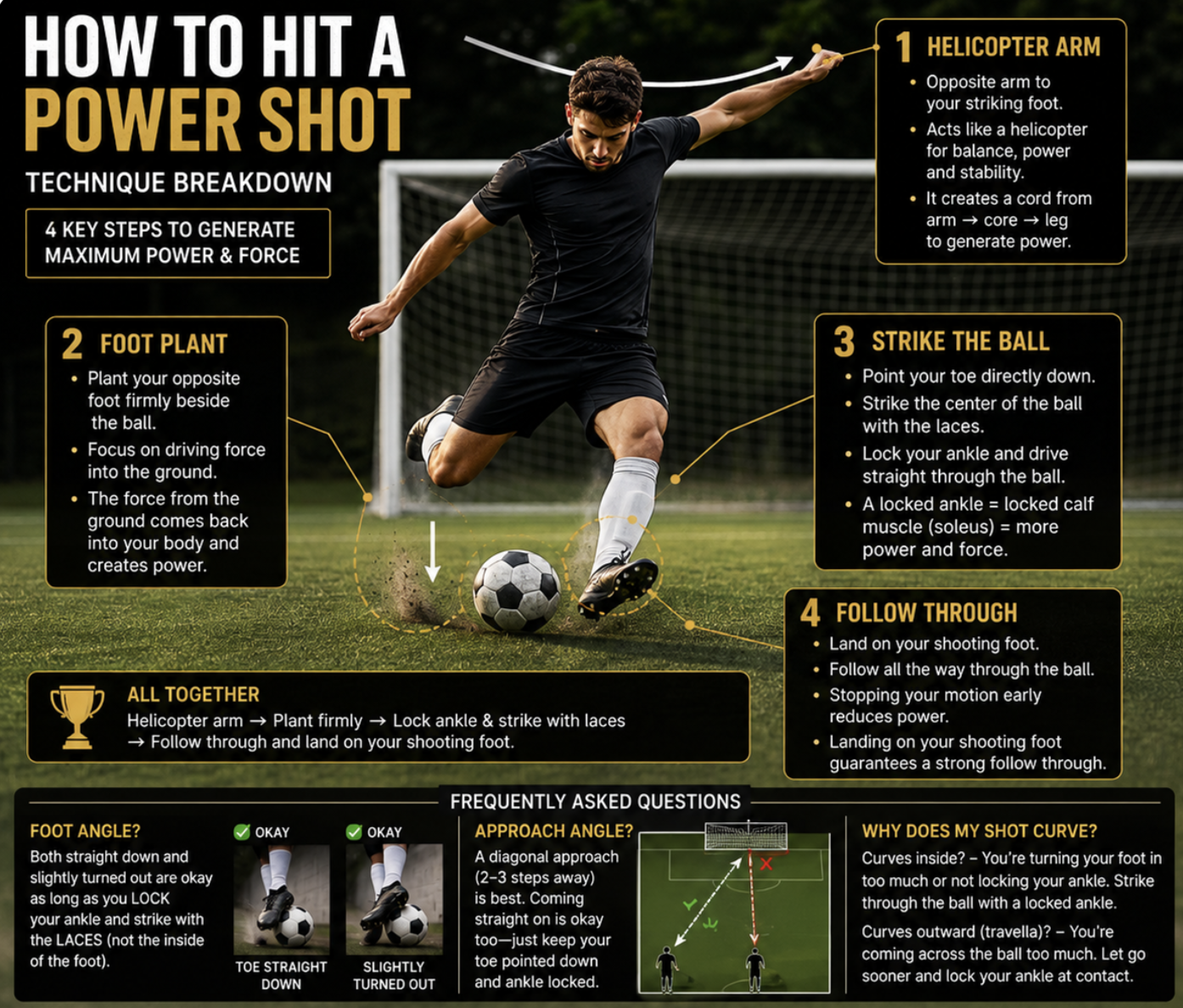
- Step 1: Lift the arm opposite from your kicking foot to the side. This provides balance and stability.
- Step 2: Plant your non-striking foot strongly next to the ball
- Step 3: Strike with your laces in the center of the ball. Don't forget to lock your ankle in place to generate more power.
- Step 4: Follow through. This means to avoid a rigid stop to your movement after you strike the ball. Doing that reduces power
Curve Shot
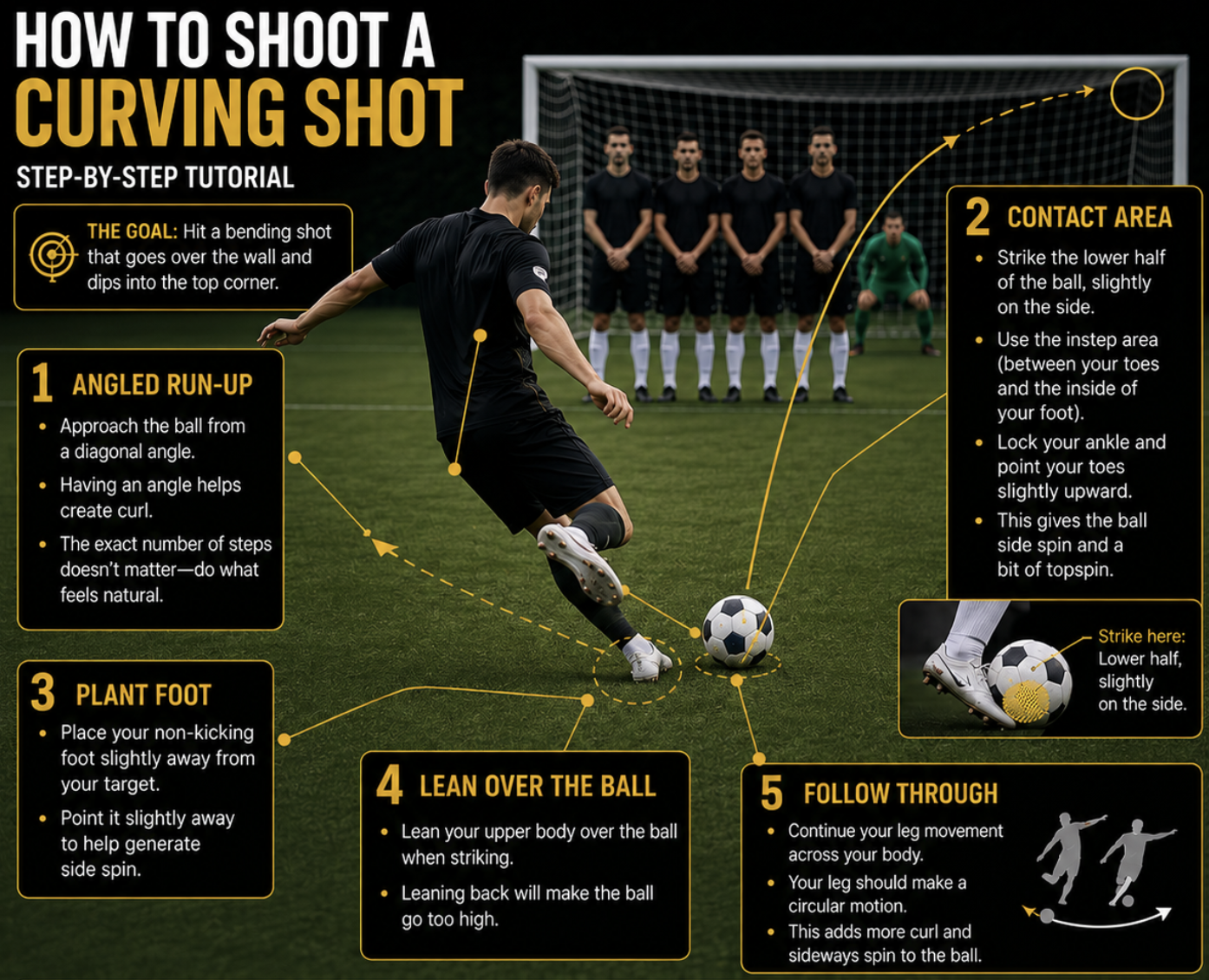
- Step 1: Make sure the run-up leading to your shot is angled, to help create the curl needed for the shot.
- Step 2: Plant your supporting foot slightly away from the ball and point it at a slight angle away from your target.
- Step 3: Strike the lower half of the ball using the instep of your foot. Don't forget to lock your ankle to generate more power.
- Step 4: Lean over the ball.
- Step 5: Follow through. This means to avoid a rigid stop to your movement after you strike the ball. Doing that reduces power
Chip Shot
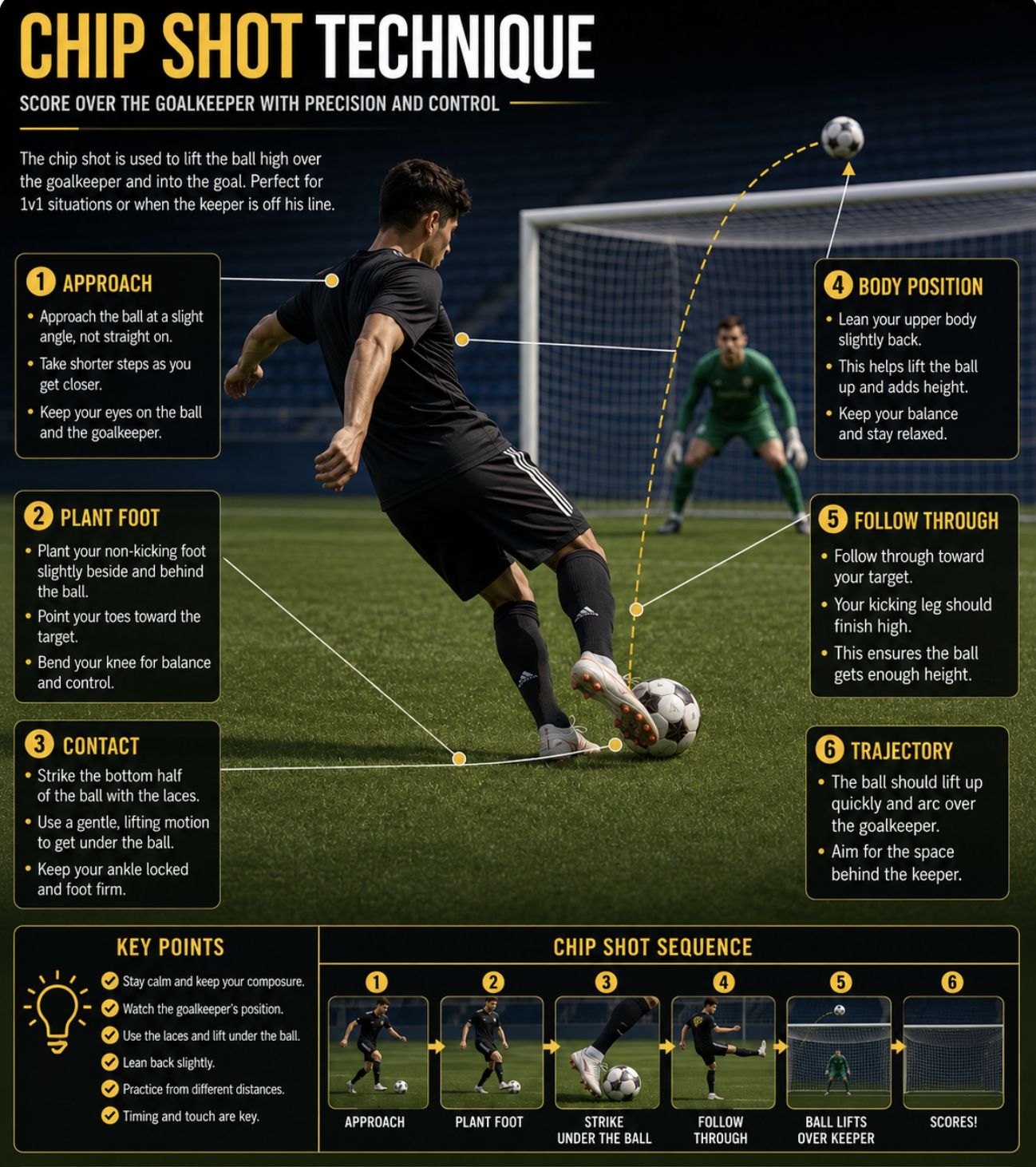
- Step 1: Approach the ball at an angle, always keeping your eyes on it
- Step 2: Plant your non-striking foot strongly next to the ball pointing towards the direction you intend the ball to travel.
- Step 3: Strike below the center of the ball with the top of your foot using a scooping technique
- Step 4: Lean slightly back. This helps create an additional lift for your shot.
- Step 5: Quickly lift your striking foot upward after contact. Keep the motion short and controlled. This helps create your shot's lift and backspin.
Low Driven
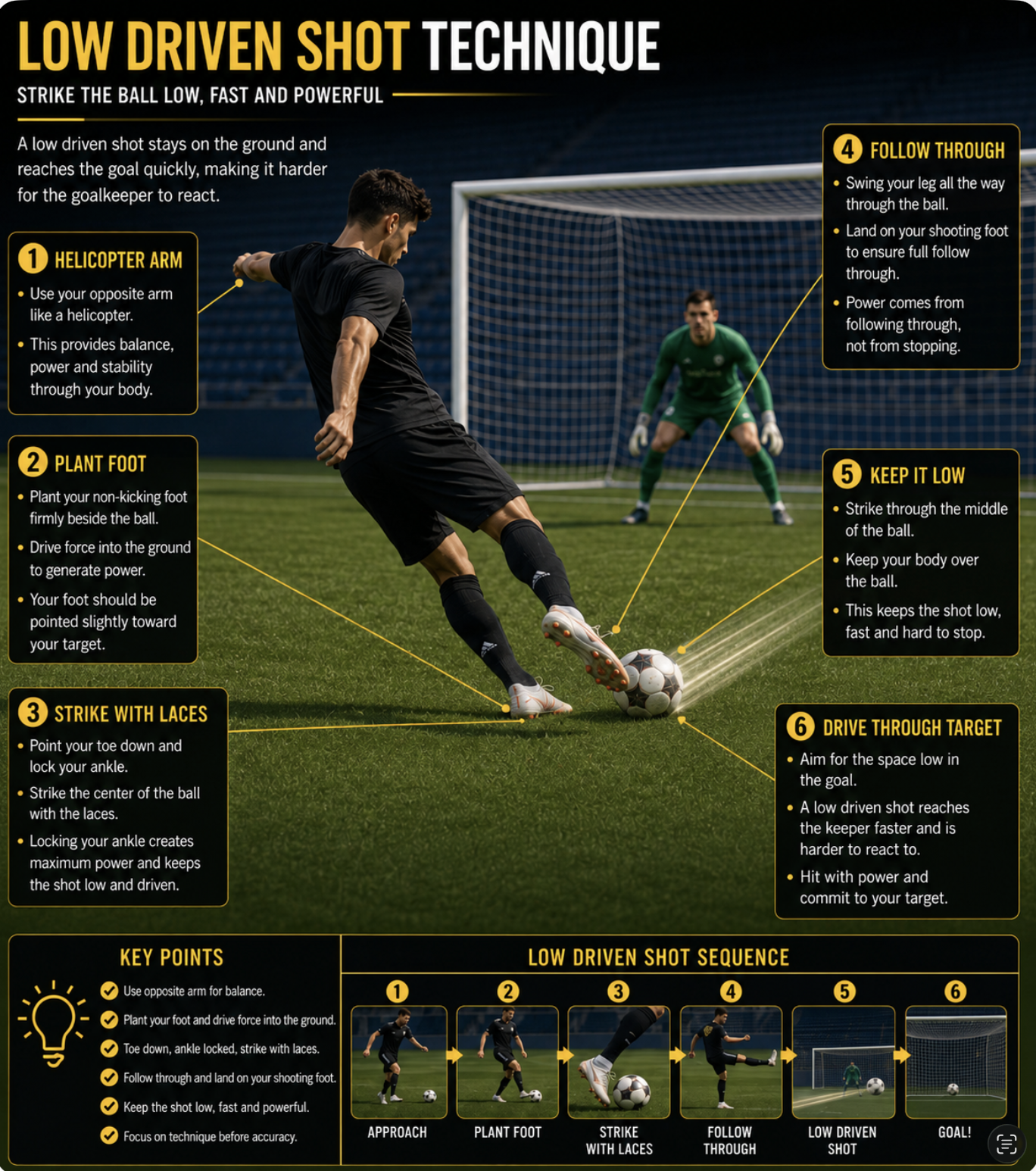
- Step 1: Use the arm opposite from your kicking foot to establish balance, power, and stability by stretching it out
- Step 2: Plant your non kicking foot next to the ball and drive force into the ground to generate more power
- Step 3: Strike the center of the ball with your laces. Don't forget to lock your ankle to generate more power.
- Step 4: Swing your leg to ensure a follow through and make sure you land on your kicking foot.
- Step 5: Keep your body over the ball
- Step 6: Aim for the bottom corner of the ball. A low powerful shot is actually harder to save for a goalkeeper.
Drills to get better (dribbling)
1. Cone Drills
- Cone drills are the best way to improve ball mastery and control. They should be practiced daily.
- Place cones within a foot's distance at first. If that starts to get too easy, proceed to place the cones closer together.
- Drill 1: Single leg Cone Weave. Start behind the first cone with the ball to the side . Use the outside of your foot to slightly tap the ball outward, then use the inside of the same foot to push it between the cones. Then, immedeately coltrol the ball with the outside of the same foot and repeat the process
2. Intervals 60m-100m

- Run at 90-100% intensity
- 6-10 repetitions
- Rest 1.5-3 minutes between sets
Drills to get better (hurdles)
1. 200-300m Hurdle Runs

- Set up 3-5 hurdles on the track (not to high if you're learning)
- Run 200-300m sections while clearing the hurdles
- Fast but controlled (80-90% effort)
- Don't sprint at the start or you will get tired
- Rest 6-10 minutes between reps
- Do 3-5 reps
2. Hurdle technique drill

- Set up 3-5 hurdles
- Place them at a comfortable distance (not full race spacing at first)
- Go over at medium or slow speed
- 4-8 runs through the hurdles
- Rest 1-2 minutes between runs
- It trains faster and cleaner hurdle clearance, less time in the air and better balance and speed
Gym Exercises
For Sprinters (at home)
1. Jump Squats

- 3 sets x 8-10 reps
- Builds explosive leg power for faster acceleration
- Focus on jumping as high as possible and landing softly
2. Bulgarian split-squats

- 3 sets x 6-8 reps each leg
- Strengthens quads, glutes and hamstrings while improving balance
- Use a chair or couch to elevate your leg
3. High knees and sprint drills

- 4 sets x 20-30 seconds
- Improves sprint technique and quick contact with the ground
- Drive your knees up as fast as possible
For Sprinters (Gym)
1. Squats

- Build strength in the quads, glutes and hamstrings
- Improve explosive power for faster starts
- Increase acceleration and sprint speed
2. Deadlift

- Strengthen glutes, hamstrings and lower back
- Improve running posture and stability
- Increase power during sprinting Increase your acceleration and sprint speed
3. Plyometrics

- Improve explosiveness and reaction speed
- Train muscles to produce force quickly
- Reduce ground contact time while running
- Help sprinters run faster and more efficiently
Workout Plan

For long distance runners
1. Walking Lunges

- 3 sets x 12-15 reps each leg
- Strengthens quads, glutes, and improves balance which leads to better running form
- Move slowly, with controlled movements
2. Plank Hold

- 3 sets x 40-60 seconds
- Improves core stability and leg endurance
- Keep your body in a straight line from head to heels, dont bend your stomach neither upwards nor downwarms
3. Step Ups

- 3 sets x 10-12 reps each leg
- Improves leg endurance and running efficiency
- Use stairs, a steady bench or a chair at home
1. Lunges

- Improve balance and coordination
- Strengthen each leg individually
- Help maintain proper running form
- Increase muscular endurance
2. Cycling

- Improve cardiovascular endurance
- Strengthen leg muscles without a lot of joint impact
- Help recovery while staying active
- Increase stamina for long runs
3. Rowing

- Improve heart and lung endurance
- Train your whole body at once
- Develop good breathing control and a steady rhythm
- Build stamina for long distance runs
It's also very important for long distance runners to train their core so they maintain breathing efficiency, hip stability through calm and controlled movements, and proper posture under fatigue. If you want to learn more, check out this source!
Workout Plan
